Sunday, 18 November 2007

Clootie Dumpling

clootie dumpling
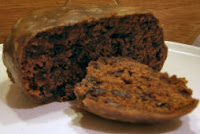
Clootie dumpling is a traditional Scottish dish, something similar to how you'd probably imagine an old traditional Christmas pudding to be. It gets its name from the cloth or 'cloot' that it's boiled in. I say it's similar to Christmas pudding, but actually it's a bit lighter - not quite so packed with fruit, and no alcohol in it.
In my family at least (and from the web searches I've done, we're not the only ones), this dish is customarily served at birthday celebrations. I remember as a child, wrapping up 20p pieces (and the occasional £1 coin) in tinfoil, to be added to the mixture before it went in the cloth. As we all got older, the coins were no longer added, but we still had the dumpling.
D had never encountered a dumpling before he met my family, and has never had one of his own. So this year, for his birthday, I thought I'd make him one.
I have my Gran's recipe for it, but it seems to be quite different from the other ones I found while doing the web searches, in that it doesn't contain the suet that almost all of the other recipes do.

So how did my first attempt at making a dumpling on my own turn out? Well, the comments from D were very favourable, and I thought it tasted OK. Will I make it again? Definitely.

Recipe
The measurements here are given in cups. The cup I use for this isn't the standard American cup, but an actual teacup. They're almost the same, but the teacup is a little bit smaller. You could probably get away with using the American cup.

2 cups plain flour, plus extra for the cloth.
1 cup breadcrumbs
3oz (85g) sugar
3oz (85g) block margarine (I used butter and it didn't seem to do any harm)
1 tsp mixed spice
1/2 tsp ground ginger
1/2 tsp ground cinnamon
1 tbsp treacle
1 cup sultanas
1 cup currants (I didn't have any, so I used raisins instead)
1 apple, grated
Pinch of salt
1 cup milk
1 tsp bicarbonate of soda

1 clean largish cotton/linen cloth, fairly tight weave.
String.
A helper is also useful.

Rub the margarine into the flour.
Add the breadcrumbs, sugar, spices and salt. Mix thoroughly.
Add the dried fruit, and stir through.
At this point, get a large pan of water boiling. Put a heatproof plate upside down in the bottom of the pan. Also boil a kettle of water.
Dissolve the bicarbonate of soda in the milk. Pour this over the dry ingredients, then add the treacle and the grated apple. mix thoroughly until well combined.
Now you need to scald the cloth - I did this by putting it in the sink and pouring the boiling water from the kettle over it. It then needs to be wrung out so that it's wet/damp but not soaking. Be careful, it's still full of boiling water. Wear at least one pair of rubber gloves - two if they'll fit.
Spread the cloth out on a surface (if the mixture isn't too runny) or in a bowl (if it is). Sprinkle the cloth with flour.
Now, spoon the dumpling mixture into the middle of the floured cloth. Here comes the bit where a helper might be useful. You need to gather up the cloth and tie it with string. Leave a bit of room for the mixture to expand, but make sure that the string is tied tightly.
Now, place the dumpling into your large pan of boiling water. Let it simmer/boil for three hours.
Before the three hours are up, preheat your oven to about 150C. It needs to be heated by the time the dumpling is ready. You'll also need to have an ovenproof plate ready, preferably slightly warmed up.
When the 3 hours are up, remove the dumpling from the pot. I dipped it in cold water at this point, but I'm not sure if you need to do this. Untie the string and start to peel the cloth away. when you have enough of the top (which will become the bottom) exposed, put the plate on top and turn the whole lot upside down. Peel away the rest of the cloth.
It doesn't look very appetizing at this point. Now, put the plate and dumpling into the oven an leave it for anything between 15 and 30 minutes. This is when the skin dries off and darkens.

Serve with custard, cream, or both.

Sunday, 11 November 2007

Pumpkin Lemon and Poppy Seed Muffins


It's been a long time since I updated this blog. I have been cooking, it's just that I just never seemed to manage to post it.
With Hallowe'en just passed, I realised that I've never cooked with pumpkin. I haven't even used one to make a pumpkin lantern. Well, here is Scotland, when i was a girl, we didn't use pumpking for lanterns, we used turnips. Anyway, in the supermarked last week, when I saw a lonely little edible pumpkin, I thought I should take it home and make something out of it.
So I did. I browsed my cookbooks, a number of blogs, and a couple of fod magazine sites, before settling on this recipe for a pumpkin, poppy seed and lemon loaf from Delicious magazine.

I didn't actually bake it as a loaf, I made individual muffins. The full recipe made 12. I cut down the sugar a tiny bit - 125g instead of 150g, and they were still sweet enough for me. I didn't need all of the milk - only 2 tablespoons instead of the 4 called for. This may have been because the pumpkin was quite watery. If I do this again (and as there's three-quarters of the pumpkin left, there will be at least one more sweet and one savoury recipe made) I'd probably cook the pureed pumpkin down a bit to get rid of the liquid.

Sunday, 23 September 2007

Bere Bannocks

bere bannocks
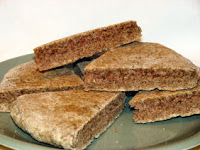
After my two attempts at making beer bread with my stash of beremeal, I thought it time to try something more traditional. When I picked up the flour, it came with a bunch of recipes, so I picked out one of the ones for bannocks, and went with that.
The recipe calls for the bannocks to be baked on a girdle, or griddle. I remember my gran having one of these. This is not the same as the ridged grill pan which is more normally meant by a griddle. A girdle is large, heavy, round or square, and completely flat. However, not having one of these, I substituted a non-stick frying pan. It seemed to work.

Recipe:
70 grams bere meal
70 grams self-raising flour
1 level teaspoon bicarbonate of soda
1 rounded teaspoon cream of tartar
1/4 teaspoon salt
1 tablespoon vegetable oil
Water, approximately 150ml

Mix the beremeal, flour, bicarbonate of soda, cream of tartar and salt in a large bowl.
Lightly oil the griddle or frying pan and place over a lowish heat. You want it to be hot by the time the dough is ready to be baked.
Make a well in the middle and add the oil.
Gradually add enough water to make into a soft dough - you may need less or more depending on your flour.
Turn onto a floured surface and shape into a round, approximately 3/4 inch thick.
Place on the griddle and bake for between 5 and 10 minutes a side over a medium heat.

Sunday, 2 September 2007

Beer Bere Bread

beer bere bread
When I was in Orkney on holiday this summer, I finally managed to pay a visit to Barony Mills. This is the only remaining working water mill in Orkney. The grain ground at this mill is a very old variety of barley, called bere. It's usually used to make bannocks - there'll usually be one in the breadbasket in Orcadian restaurants.
Anyway, while at the mill I picked up the recipe leaflet and a bag of beremeal. The leaflet contains recipes for everything from the traditional bannocks (multiple variations) to beremeal chapatis. However, I never really got round to trying anything.
Until I came across a recipe for beer bread on Farmgirl Fare. Now, bere also used to be used to brew ale, so what could be more appropriate? I believe there are some beers still being brewed from bere (one for sure on Shetland, and one possibly on Orkney), but being unable to get hold of any, I had to make do with what I could get get. On my partner's recommendation, I used Hoegaarden.
So how did the bread turn out? Well, not too bad, but I'm not entirely happy with it. I think it'll take a few more tries before I come up with something I'm happy with. But I've got most of a bag of bere left to play with.

Recipe:
Although it didn't turn out quite right for me, I'll still include the recipe I used this time.

250 grams plain white flour
120 grams beremeal
50 grams white bread flour
1 tablespoon sugar
1 tablespoon baking powder
1 teaspoon salt
330 ml beer
30 ml water

Preheat the oven to 190C.
Combine the dry ingredients in a large bowl.
Slowly stir in the beer and water, and mix until just combined.
Spread the dough in a 1 pound (8 inch by 4 inch) loaf pan.
Bake for around 60 minutes.

Sunday, 12 August 2007

Double Chocolate Day

muffins and brownies
There's a guy that Duncan works with, P, who's allergic to eggs. I used to feel guilty every time Duncan took some of my baking to work - it all had eggs in it, and P couldn't have any of it. So, Amazon to the rescue. I found a book on baking wthout eggs (Bakin' Without Eggs by Rosemarie Emro), and started baking a few things from it, which seemed to be fairly well received. But then I sort of stopped baking as often, and things didn't go to work with Duncan.

However, P recently helped me out with sourcing a good price on my Dad's birthday present. He's good at that kind of thing, among all the other stuff he does to help people out, and I figured he deserved a little thank you. So I dug out the egg-free baking book, and whipped up a batch of the chocolate muffins that had gone down so well before. Apparently they went down pretty well this time too - not just with P, but with everybody else there too. So well, that I'm making another batch this weekend. Although, for variety, I plan on using Green & Black's Maya Gold cocoa, instead of their plain cocoa powder. Hopefully that should give a slight orange spice taste to them.

As the chocolate muffins were going to work, I thought we might need something else chocolatey to stay behind. This time, it was out with the not-quite-so-bad-for-you baking book (One Smart Cookie by Julie van Rosendaal), and into the chapter on brownies, where I picked a simple plain chocolate brownie.

Recipes:

Chocolate Sour Cream Cupcakes
(Adapted from Bakin' Without Eggs by Rosemarie Emro)
225 grams plain flour
50 grams cocoa powder
1 teaspoon baking soda
225 grams sugar
250 ml sour cream
125 ml vegetable oil
2 teaspoons vanilla extract
125 ml soda water

Preheat oven to 350F/180C Placu muffin cases in muffin tin.
In a large bowl, sift together the flour, cocoa and baking powder. Add the sugar and mix through.
In a jug, beat together the sour cream, vegetable oil, vanilla and soda water.
Add the wet ingredients to the dry, and stir until completely mixed.
Divide between muffin cases.
Bake for 15 to 20 minutes.


Easy Cocoa Brownies
(Adapted from One Smart Cookie by Julie van Rosendaal)
50 grams unsalted butter -- melted
200 grams caster sugar
1 large egg
2 large egg whites
1 teaspoon vanilla extract
1 teaspoon instant coffee granules -- dissolved in 1 teaspoon water
140 grams plain flour
50 grams cocoa powder
1/4 teaspoon baking powder
1/4 teaspoon salt

Preheat the oven to 350F/175C. Line an 8x8 inch pan with non-stick baking parchment.
In a large bowl, mix together the butter and sugar until well combined.
Add the egg, egg whites, vanilla and coffee. Stir until thoroughly blended and smooth.
In another bowl, combine the flour, cocoa, baking powder and salt.
Add the dry ingredients, together with any optional additions, to the egg mixture and stir until just combined. Do not overmix.
Spread the batter in the pan. Bake for 25 - 30 minutes, until the edge is starting to pull away but the middle is still slightly soft. Do not overbake.
Cool in the pan. Cuts into 16 pieces.